Skip to content

ACTIVITY 7: Sending Signals

ACTIVITY 7: Sending Signals

How I Am (Intrapersonal Skills)

This section has students look at how they act, feel, and think. Topics covered include self-esteem, social image, decision-making skills, and personal values (what is important to each student). The activities are designed to provide students with a chance to practice decision making and to empower them to make healthy choices.

SKILLS

SKILLS: Building Self-Esteem/Understanding Personal Values

Suggested Time Consideration

Suggested Time Consideration: 20 mins

RATIONALE

What’s important to an individual influences his or her decisions. This exercise is designed to help students understand what sorts of things they value and how they communicate that information to others. It will help them think about what image they want to portray.

GETTING STARTED

Share the digital activity link with students and tell them they’ll be making a list of things that are important to them. You may want to offer some examples (e.g., family, religion, a pet, sports, honesty, etc.). In other words, items of importance can be people, places, things, or even concepts.

While there is no set amount of items, encourage students to come up with at least ten.

After students make their lists, they will be asked to write down ways in which they communicate or show others what is important to them. Again, you may want to offer some examples. A religious person, for instance, may wear a religious icon around his or her neck. An athlete may hang a poster of his or her favorite team in his or her locker. A person who values honesty may have a reputation for beginning sentences with, “I don’t know if you want to hear this, but to be honest with you…”

Launch Activity
TALKING ABOUT IT

In getting students to talk about what’s important to them and how they communicate that to others, encourage discussion about positive and negative ways of communicating values. Get them to discuss not only what they are communicating but how it is being received by the other person. For instance, one young man may put a great deal of importance on his role as a member of the school’s football team, but if he is conveying this to someone who tried out for the team but didn’t make it, he might make that person feel envious and resentful. You may want to role-play some of these. For instance:

  • Choose two students.
  • Give one a piece of paper on which you have written: “You have just been introduced to the person across from you. One of the most important members of your family is your pet dog, Oscar. You never tire of telling Oscar stories, and you decide to communicate Oscar’s importance in your life to this person.”
  • Give the other person a piece of paper on which you have written: “You have just been introduced to the person across from you. During the course of your conversation this person is going to communicate to you something that is important to him or her. Recently, your family had to put your 14-year-old family dog to sleep.”


Have the class discuss this from two perspectives:

1) There is nothing wrong with knowing what is important to you and communicating it to others; and
2) This should be done with sensitivity.

WRAPPING UP

Ask students to volunteer answers to the question in the “You Decide!” section of the activity, which asks how being tobacco and nicotine free reflects what’s important to them. Take the opportunity to encourage students to see that using tobacco and nicotine does not reflect a positive image or healthy lifestyle. Ask students to give you examples of words and actions that do exhibit positive images and a healthy lifestyle. Write their ideas on chart paper and post it in the room as a reminder to students.

LAUNCH ACTIVITY

GO!

ACTIVITY 8: Decisions, Decisions!

ACTIVITY 8: Decisions, Decisions!

How I Am (Intrapersonal Skills)

This section has students look at how they act, feel, and think. Topics covered include self-esteem, social image, decision-making skills, and personal values (what is important to each student). The activities are designed to provide students with a chance to practice decision making and to empower them to make healthy choices.

SKILLS

SKILLS: Decision Making

Suggested Time Consideration

Suggested Time Consideration: 20 mins

RATIONALE

In this activity, students will apply what they have learned about themselves and the decision-making process to evaluate a series of situations they may experience. (See the Overview Booklet for additional information about decision making that you can share with your students).

GETTING STARTED

Before starting the activity, review with your students the decision-making steps outlined in the activity:

Decision-Making Steps

  • Situation: Why do you need to make a decision?
  • Goals: What do you want to happen?
  • Choices: What are your options or alternatives?
  • Consequences: What could happen?
  • Decisions: What will you do?
  • Think about it: Did you make the right decision?

Then, to reinforce the steps, present students with the following example before they complete the activity:

Your parents have gone out, and you have been put in charge of watching your little brother for the night. Your friends call you and want to come over to hang out with you. You aren’t supposed to have anyone over when your parents are not there. But your friends are being pushy, and you really want to hang out with them. What do you do?

Take your students through the decision-making steps, by asking them:

  • What’s the goal? Or what do you want to happen?
  • What choices or alternatives do you have?
  • What are the possible consequences for each option?
  • What would you do?

Next, share the digital activity link and have students complete the activity independently or in groups.

Launch Activity
TALKING ABOUT IT

Regroup to review the answer as a class. Ask students to volunteer their lists of options, consequences, and decisions for each hypothetical situation.

WRAPPING UP

To wrap up, encourage students to talk about how helpful it is to break down the decision-making steps. Ask them how some of these decisions (or other decisions they’ve made in their own lives) might have been made differently if they had thought them through.

LAUNCH ACTIVITY

GO!

ACTIVITY 6: Dealing with Stress

ACTIVITY 6: Dealing with Stress

How I Am (Intrapersonal Skills)

This section has students look at how they act, feel, and think. Topics covered include self-esteem, social image, decision-making skills, and personal values (what is important to each student). The activities are designed to provide students with a chance to practice decision making and to empower them to make healthy choices.

SKILLS

SKILLS: Understanding Stress Triggers / Taking Care Of One's Health

Suggested Time Consideration

Suggested Time Consideration: 20 mins

RATIONALE

Adolescence can be a time of high stress. Students are growing and changing biologically. They are eager to gain independence from their parents, who are not always willing to grant it. They are increasingly aware of the stressors that exist in the wider society (street violence, unemployment, war, disease, etc.). Schoolwork is more difficult. Peers and peer approval grow in importance. But peer approval is not always easily earned.
 
Learning to manage and reduce stress can be an important life skill for adolescents. Some adolescents may have the misperception that alcohol and tobacco or vaping can help them reduce stress. The information below can help you dispel that myth. What students must learn in these years is how to identify stress, what to do to cope with it, and what to avoid when coping with it.
 
This activity will help students identify sources of stress in their own lives and offers some tips for coping.

GETTING STARTED

Share the digital activity link and ask students to answer the questions independently.

LAUNCH ACTIVITY
TALKING ABOUT IT

Once they are done, ask students to consider what situations are the most stressful to them. They may refer back to their activity responses to gather ideas and/or discuss whatever comes to mind. Tally their answers on the board. Discuss the patterns of similarity and difference in their responses. Find out if your students were surprised by some of the responses.

Next, discuss the coping strategies that are included in the activity:

  • Take inventory.
  • Make a plan.
  • Be healthy.
  • Get support.
  • Give yourself a break.
  • Break it down.

Do any students engage in them? How effective are they? Ask students if there are other coping mechanisms they employ that are not listed.

WRAPPING UP

Take a few minutes to talk about tobacco and nicotine use. Students may have the misperception that people smoke or vape to relax. Explain to your students:

  • Using tobacco and nicotine causes health issues, which are not relaxing.
  • Adolescents who use tobacco or nicotine often hide this fact. This, in itself, becomes a constant source of stress.
  • People under 18 can’t purchase tobacco or nicotine products legally, so trying to get them, as well as the cost involved, can cause stress.
FOLLOW-UP ACTIVITY

After students have gone over this material, organize them into small groups to research and devise strategies for reducing and coping with stress. Explain that there are lots of ways people can cope with stress. Some people do breathing exercises or meditate. Others exercise or do yoga. Some people listen to music or talk to friends. It’s a personal decision.

Each group should research a way young people can reduce stress and present the method to the class. They can then create a brochure or poster to reflect what they have learned.

Some suggestions might include:

  • Organizing peer support groups
  • Organizing daily exercise times
  • Having a family therapist come to school to talk with students and parents about how they can reduce tensions at home
  • Creating a brochure of stress management techniques
  • Suggesting music to listen to
  • Practicing abdominal breathing exercises
  • Relaxing muscles
  • Visualizing

Use the supplemental “Stressed” video to complement this section.

LAUNCH ACTIVITY

GO!

ACTIVITY 5: When Saying “No” Is the Way to Go

ACTIVITY 5: When Saying “No” Is the Way to Go

How Friends Fit In (Interpersonal Skills)

In this section, students explore their relationships with others. The activities focus on peer relationships and how peer pressure, influence, and acceptance affect their lives. There are also activities on refusal skills to help equip students with strategies for saying "no".

SKILLS

SKILLS: Refusal Skills

Suggested Time Consideration

Suggested Time Consideration: 30 mins

RATIONALE

Students need to be reminded that it sometimes takes skills to extricate themselves from uncomfortable or embarrassing situations. If, for instance, a girl is asked out on a date by a boy she has no interest in, but whose feelings she doesn’t want to hurt, she is going to want to use tact in her refusal.

In this activity, students will practice saying “no” to their friends.

GETTING STARTED

First, display the refusal skills wall poster in the “Materials” section below. Students will also see it on screen. Go over the tips about how to say “no” to different situations. For instance:

  • Humor can be useful: “I want to keep my pearly whites—they come in handy when meeting girls/guys.”
  • Change the subject: “Nah, I don’t want a beer. But let’s get a pizza.” Or “No thanks, I don’t want a vape. What happened on our favorite TV show last night?”
  • Talk about the consequences: “No, thanks. In fact, I don’t want to ever start smoking or vaping, and I’ll tell you why. I don’t want to be unhealthy.”
  • Reverse the pressure: “Why in the world would I want to break into that abandoned house? Why would you want to do such a dumb thing?”
  • Suggest something else: “No, I don’t want to get into your parents’ liquor cabinet, but how about going into the kitchen for something to eat?”
  • Give a convincing reason: “I’m not gonna let you copy my homework, because it’s not fair.” OR “I’d love to stay out later, but my parents have set a ridiculous curfew, and they’re really inflexible about it.”
  • Walk away.

Share the digital activity link with students and explain that they are to decide if they will say “yes” or “no” to each situation. Let them know that as a group, you will discuss different ways of saying “no.”

LAUNCH ACTIVITY
TALKING ABOUT IT

Go over your students’ answers together. In discussion, keep in mind how important it is for students of this age to “save face” and “fit in” with their peers. Try to get the students to talk about how to manage a situation in which they want to both say “no” and remain a valued member of the group.

WRAPPING UP

To wrap up, talk about the difference between rejecting an idea or an action (“I don’t like the idea of smoking…”) and rejecting a person (“…but that doesn’t mean I don’t like you”).

Use the supplemental “Geek at the Party” video to complement this section.

LAUNCH ACTIVITY

GO!

How Friends Fit In (Interpersonal Skills)

In this section, students explore their relationships with others. The activities focus on peer relationships and how peer pressure, influence, and acceptance affect their lives. There are also activities on refusal skills to help equip students with strategies for saying "no".

SKILLS

SKILLS: Understanding/Dealing With Peer Pressure, Influence, and Acceptance

Suggested Time Consideration

Suggested Time Consideration: 60 mins

RATIONALE

In this activity, students will write and act out skits that depict peer pressure and peer influence so that they can better understand options for how to handle both of these. (See the Overview Booklet for additional information about peer pressure and peer influence that you can share with your students.)

GETTING STARTED

Begin by reminding students about the difference between peer pressure (which is exerted when peers try to coax a person into doing something) and peer influence (which occurs when a person is not coaxed or coerced, but comes to behave in a certain way because he or she thinks it’s what will make others accept him/her.) Provide examples for students:

  • Peer pressure: You are at the high diving board at the county pool, and your friends are diving off. You don’t want to, but they say you’re a baby if you don’t. They dare you, so you go ahead and try it.
  • Peer influence: Someone at school is taking up a collection for a hurricane relief fund. You gave money to a similar fund yesterday, so you don’t want to do so again. But when the person comes to your lunch table, you notice that all of your friends donate money. You do too, because you think they will think ill of you if you don’t.

Organize the students into small groups and share the digital activity link with them. Explain that each group’s assignment is to create a skit that displays peer pressure or peer influence. Peer influence can be depicted as positive or negative.

LAUNCH ACTIVITY
TALKING ABOUT IT

After each group performs its skit, ask the students why they chose their topic, and why they depicted it the way they did. Open the discussion to the entire classroom and ask for feedback.

  • Was the skit realistic?
  • Could other students identify with the dilemmas that were presented?
WRAPPING UP

To wrap up, have students reiterate the notion that they don’t have to succumb to peer influence or pressure to be liked and accepted by their true friends. One way to do this is to ask students whether they would think any less of a friend who refused to be pressured into something by them. If not, why should they expect any less from that friend? For instance, pose this scenario:


You want to borrow money from a good friend, but she turns you down. You remind her of the times you’ve lent her money. You tell her how much you need the money, and you tell her that this is what friends do for one another. She answers by telling you that while she very much appreciates the times you have lent her money, she simply can’t afford to lend you any right now.


Ask your students:

  • How would you react if you were the one in need of money?
  • You may be disappointed with your friend, but will you abandon her as a friend?

Emphasize to your students that they are unlikely to abandon a friend for saying “no.” Nor would the friend abandon them if they did the same.

LAUNCH ACTIVITY

GO!

ACTIVITY 3: Tobacco & Nicotine Use - The Health Consequences

ACTIVITY 3: Tobacco & Nicotine Use - The Health Consequences

Keeping Healthy

This section includes a survey to determine students' perceptions about tobacco and nicotine, their understanding of its effects, and their experience with it. In addition, it includes activities to educate students about the health consequences of tobacco and nicotine use.

SKILLS

SKILLS: Assessing Risks and Consequences

Suggested Time Consideration

Suggested Time Consideration: 25 mins

RATIONALE

While your students have learned about the health consequences of tobacco and nicotine use in previous grades, it is a good time to refresh their knowledge about these issues. Developmentally, your students are at a pivotal stage. It’s a time when more of them may be experimenting with tobacco and nicotine – by using vapes – or may have friends who are.
 
This activity is designed to remind students about some of the health consequences associated with smoking, vaping and using smokeless tobacco. Knowing the facts and understanding the severity of the health risks may prevent students from experimenting or stop them if they already use tobacco or nicotine.
 
You might consider having the school nurse or health teacher join you for this activity. Have a dictionary or health textbook on hand so students can look up unfamiliar terms and share them with the class. You may also wish to have them refer to the Glossary included on this site.

GETTING STARTED

You may choose to present this activity on an interactive whiteboard or have students complete it individually or in small groups at computers. Share the digital activity link with your students and then review the information in the activity with your class. Have students take turns reading the activity material aloud and suggesting answers.

Launch Activity
TALKING ABOUT IT

After reading the facts presented in the activity, have a discussion to get students’ reactions to the health consequences. Ask students:

Knowing this information, why do you think some people risk using tobacco or nicotine?

WRAPPING UP

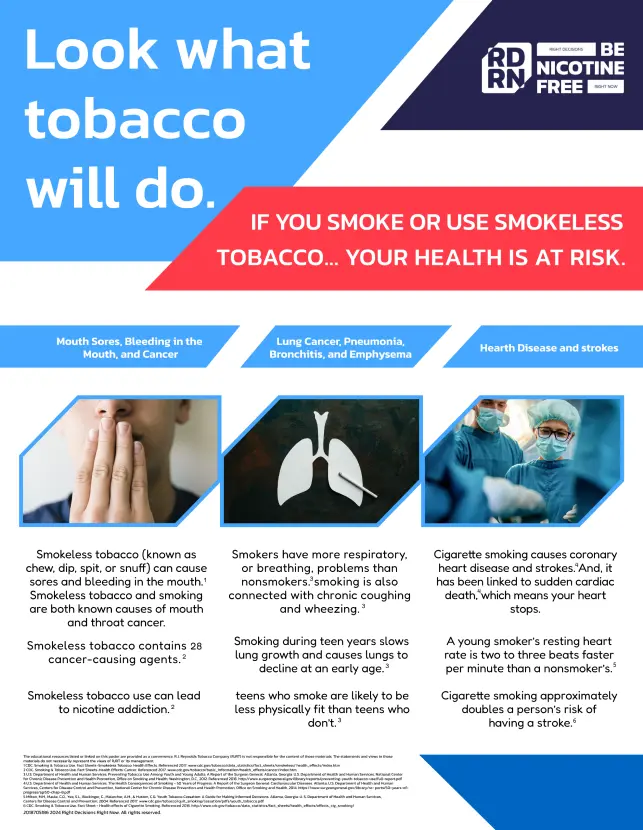
Before completing the lesson, present the “Look what tobacco/nicotine will do” poster depicting some health consequences associated with tobacco use. It is included in the “Activity Resources” section below. Read the poster with your students and ask them to comment on the facts that are presented. Emphasize to students that these are health risks tobacco and nicotine users face. The best way to avoid these issues is not to use tobacco or nicotine.

To reinforce the seriousness of the situation, students might research stories of young people affected by tobacco or nicotine use or speak to a local healthcare provider. Or, as a class, visit the CDC’s website for additional information on health consequences.

FOLLOW-UP ACTIVITY

Use the supplemental “Gamers” video to complement this section.

Have small groups of students research the health consequences of tobacco and nicotine use and create posters of their findings to educate other students and encourage them to be tobacco and nicotine free. Students will find the “Look what tobacco/nicotine will do” poster and the material to create their own digital posters at the Follow-Up Activity link below. Share the link with students. Consider having students create presentations to complement their posters and share with the class.

LAUNCH ACTIVITY

GO!

ACTIVITY 2: It’s Your Health

ACTIVITY 2: It’s Your Health

Keeping Healthy

This section includes a survey to determine students' perceptions about tobacco and nicotine, their understanding of its effects, and their experience with it. In addition, it includes activities to educate students about the health consequences of tobacco and nicotine use.

SKILLS

SKILLS: Assessing Risks and Consequences

Suggested Time Consideration

Suggested Time Consideration: 20 mins

RATIONALE

Your students know that there are health consequences with tobacco and nicotine use, but do they know the specifics? Do they think smoking and vaping-related diseases and side effects can affect only adults or people who have smoked for years?

The risks are serious! Health consequences of smoking, such as cancer, heart disease, emphysema,11 and nicotine use consequences to brain development including nicotine addiction, mood disorders, permanent lowering of impulse control, and impact to attention and learning 4 will give your students something to think about—especially if they are considering or currently using tobacco or nicotine.

GETTING STARTED

To introduce this activity, ask students what they think of when they hear the words “tobacco, nicotine or vaping.” Refute any notions that smoking or vaping is “appealing” by referencing the health consequences listed under “Talking About It.”
 
For example, if a student says smoking or vaping is appealing because it makes people look “cool,” ask what’s cool about a person who reeks of smoke - or who’s addicted to nicotine?
 
Share the digital activity link and ask students to answer the questions independently.

LAUNCH ACTIVITY
TALKING ABOUT IT

Review the answers as a class.

Answers, Numbers 1–8

1) Using tobacco can cause me to have bad breath (halitosis), stained teeth, and__________.
a. Oily skin
b. Bleeding in the mouth
c. Acne
Stained teeth, bad breath, and bleeding in the mouth are all consequences of using tobacco.8

2) If I smoke, I am at risk for the following disease(s):
a. Heart disease
b. Lung cancer
c. Emphysema (a lung condition resulting in labored breathing and susceptibility to infection)
d. All of the above
All of the diseases listed are health consequences of tobacco use. 

3) If I smoke, the toxins released from cigarette smoke travel_________.
a. To my heart
b. To my lungs
c. Everywhere the blood flows in my body
The toxic ingredients in cigarette smoke travel throughout the body.9

4) If I use a smokeless tobacco, I am at risk for the following disease(s):
a. Gum disease
b. Mouth sores
c. Cancer of the mouth
d. All of the above
All of these diseases can be caused by smokeless tobacco.11 

5) In the U.S., ______ is the leading preventable cause of death.
a. Alcohol
b. Cigarette smoking
c. Drugs
Cigarette smoking is responsible for about 1out of 5 deaths per year in the U.S., or about 480,000 deaths.9 

6) Second hand smoke exposure harms and kills people in the U.S.
a. True
b. False
Since 1964, about 2,500,000 people who did not smoke died from health problems caused by second hand smoke exposure. 6

7) Throughout the world, tobacco use results in approximately _____deaths per year.13 
a. 1 million
b. 5.4 million
c. 10 million
Worldwide, approximately 5 million people die each year resulting from tobacco use.13 

8) Nicotine is a chemical found in tobacco that is__________.6 
a. Not harmful
b. Addictive for adults only
c. Addictive for adults and young people
Nicotine is an addictive drug that can affect adults and young people. Most young people who smoke regularly are addicted tonicotine.6 

Answers and Correct Statements, Letters A—F

A) TRUE. Nicotine is a drug.
B) TRUE. A person’s blood sugar and breathing rate are both increased by nicotine.
C) FALSE. In order to be “True,” the statement should say: Neurons are also referred to as brain cells.
D) TRUE. The limbic system is the brain’s pleasure and reward circuit.
E) FALSE. In order to be “True,” the statement should say: Without nicotine, a smoker feels irritable and depressed.
F) TRUE. Nicotine causes the same changes in the brain as heroin and cocaine.

WRAPPING UP

Review the information about nicotine addiction with your students.

When a person is dependent on (or is addicted to) nicotine and stops using it, their body and brain must get used to not having nicotine. This can result in temporary symptoms of nicotine withdrawal. People might keep using tobacco products, like vapes, to try to make these symptoms feel better. Nicotine withdrawal symptoms include:

  • Irritability
  • Restlessness
  • Feeling anxious or depressed
  • Trouble sleeping
  • Problems concentrating
  • Craving nicotine
  • Youth might turn to vaping to try to deal with stress or anxiety. This can create a cycle of nicotine addiction, which can also be a source of stress.

Youth vaping and cigarette use have also been linked to mental health symptoms, such as depression.7

Emphasize that nicotine addiction is real that it can and does happen to young people-it’s not just an adult issue. The safest way to avoid addiction is never to use tobacco or nicotine products.

FOLLOW-UP ACTIVITY

Have your students research testimonials from people who smoked, vaped or used other tobacco/nicotine products and have tried to quit—successfully or unsuccessfully. Understanding the plight of others may deter some students from using tobacco and nicotine.

SOURCES

LAUNCH ACTIVITY

GO!

ACTIVITY 1: Take a Tobacco and Nicotine Survey

ACTIVITY 1: Take a Tobacco and Nicotine Survey

SKILLS

SKILLS: Assessing Risks and Consequences

Suggested Time Consideration

Suggested Time Consideration: 25 mins

RDRN Activity Page

The first activity in this unit is a student survey which will enable you to better assess your students’ understanding of and experience with tobacco and nicotine. It will help you more effectively implement this unit and address students’ questions and concerns. But first, be sure to read the Overview Booklet for Grades 5–9. It provides all the information you need to know to successfully implement this material.

The topics presented in the survey will be addressed throughout the program materials. For instance, students will be provided with facts related to the health consequences of tobacco and nicotine use and learn refusal skills they can use to remain tobacco and nicotine free.

Survey, Parts One and Two

Part One of the survey asks students about their experience with tobacco. It includes questions taken from the CDC’s National Youth Tobacco Survey (NYTS) - a survey that can be used to estimate current use of tobacco products and selected indicators related to tobacco use among U.S. middle school and high school students. These surveys are periodically done by the government to assess tobacco and nicotine use. The survey and report are available online here.

Part Two of the survey consists mostly of open-ended questions that ask students what they think or know about the prevalence and health consequences of tobacco and nicotine use, the benefits of quitting, and why some young people use tobacco and nicotine. Students are also asked if they’ve ever felt pressured to use tobacco or nicotine products.

Once you have completed all activities, please delete or dispose of all student surveys.

RATIONALE

Collectively, the two-part survey will give you insight into your students’ experience with tobacco and nicotine, their perceptions about tobacco and nicotine use, and their prior knowledge of the facts.
 
Since the survey asks students about their personal experience with tobacco and nicotine, it should be done independently and anonymously. Assure students that no personally identifying information will be included in the survey they email to you.

GETTING STARTED

Before distributing the activity, explain to your class that they are going to take a survey about tobacco and nicotine. Instruct them that they will also learn facts about tobacco and nicotine use and tips for coping with peer pressure in this unit.

Then, direct your students to the online survey on the website by clicking the link below. We recommend emailing the link to them, posting it on a class webpage, projecting it on an interactive whiteboard, and/or writing it on a chalkboard. Remind students that their answers will be anonymous.

Encourage students to answer the questions as honestly as they can. Let them know that the first eight questions ask them about their experience with tobacco and nicotine and are only going to be used by you to get a sense of what they have experienced.

Inform them that once they are done with the survey, you will share some information with them related to Part Two. Explain that being informed is an important element in making the right decisions. Encourage students to volunteer answers if they feel comfortable.

LAUNCH ACTIVITY
TALKING ABOUT IT

Once the survey is complete, share with your students the facts listed in the answer key part of the “Wrapping Up” section to help dispel misperceptions they may have about tobacco and nicotine use.

WRAPPING UP
Answers, part one

Answers will vary. Review the answers students provided for questions 1. This will give you a sense of your students’ experience with tobacco and nicotine but should not be shared with the students.

Answers, part two

1. Explain to students that most young people do not smoke or vape. Only about 1 of every 100 middle school students (1.0%) reported that they had smoked cigarettes in the past 30 days, and 1 out of every 30 middle school students (3.3%) reported that they had used electronic cigarettes (vapes) in the past 30 days.1 Point out to students that the younger people are when they start smoking, the more likely they are to become addicted.3   

4. Ask students if they want to volunteer answers about why young people smoke or vape. Note their answers on the board. Explain to students that some of the reasons young people try or start to use tobacco and nicotine include: 2,3

  • They don’t feel good about themselves (low self-esteem and self-image).
  • They don’t know about the health consequences of smokeless tobacco.
  • They think lots of people smoke (overestimating the number of people who smoke/vape).
  • They don’t realize that they can become addicted (not understanding the addictive potential of nicotine).  

5. Ask students if they want to volunteer answers about why they think young people choose to be tobacco and nicotine free. Explain that some people may choose to be tobacco and nicotine free because:3,4 

  • Their friends don’t use tobacco or nicotine.
  • They know about the health consequences.
  • They want to be tobacco and nicotine free. 

6. Explain to students that some young people try tobacco because of a “clack of self-efficacy in the ability to refuse offers to use tobacco,”3  or they don’t know how to tell their friends they don’t want to try it. 

Explain to students that people their age are sometimes pressured to use tobacco or nicotine products, and that pressure can be difficult to handle. Let them know that in this unit, they are going to learn some ways to say “no” and cope with peer pressure so they can be tobacco and nicotine free. 

If students volunteer stories, remind them not to use names. Listen to their concerns and explain to students that feeling pressure from friends happens, but that they will learn some ways to deal with the pressure.

8. Explain to students that there are health consequences related to tobacco and nicotine use and they will learn more about them in Activities Two and Three. If students want to volunteer answers, write them on the board and then revisit the list when you read Activity Three to see which ones are listed. 

9. Students might have heard that quitting tobacco and nicotine is difficult, but they may not know why. To illustrate the difficulty of quitting, offer this CDC statistic: “Most students who use tobacco products want to quit and have attempted to do so. This includes e-cigarettes. In 2020, nearly 2 in 3 middle and high school students who used e-cigarettes reported wanting to quit. Similarly, about 2 in 3 reported trying to quit in the last year.”3 Tell students that they will learn about nicotine’s addictive nature in detail later in the unit. 

10. Answers will vary. However, explain to your students that most teens strongly dislike being around smokers.2 For additional information on factors that influence young people to use tobacco and nicotine and for reasons most of them abstain, review the Overview Booklet. 

To end the lesson, display the “Tobacco and Nicotine: Myth or Reality?” poster in the “Materials” section and review the content with your students. The poster will reinforce the message that most young people are tobacco free.

SURVEY DATA COLLECTOR

To assist you with evaluating your students’ anonymous responses to this survey, we have created a data collection spreadsheet that will allow you to input and view quantitative and qualitative measures. Click here to access the downloadable survey-response spreadsheet.

SOURCES

1CDC. Smoking & Tobacco Use. Fact Sheet Youth and Tobacco Use: Current Estimates of Youth Tobacco Use. Referenced 2023. www.cdc.gov/tobacco/data_statistics/fact_sheets/youth_data/tobacco_use/index.htm

2https://www.ncbi.nlm.nih.gov/books/NBK99236/#ch4.s1

3 U.S. Department of Health and Human Services. Preventing Tobacco Use Among Youth and Young Adults: A Report of theSurgeon General. Atlanta, Georgia: U.S. Department of Health and Human Services, National Center for Chronic Disease Prevention and Health Promotion, Office on Smoking and Health; Washington, D.C., 2012. Referenced 2023. www.surgeongeneral.gov/library/reports/preventing-youth-tobacco-use/full-report.pdf

4 https://e-cigarettes.surgeongeneral.gov/knowtherisks.html#:~:text=Youth%20and%20young%20adults%20are,permanent%20lowering%20of%20impulse%20control.

5 CDC. Morbidity and Mortality Weekly Report, Quitting Smoking Among Adults — United States, 2001—2010, November 11, 2011.Vol. 47, No. 19. Referenced 2023. www.cdc.gov/mmwr/preview/mmwrhtml/mm6044a2.html

LAUNCH ACTIVITY

GO!

GRADES 8 & 9

GRADES 8 & 9