One of the most important parts of a conflict is how you choose to respond to it. Before you react, stop and think! Decide how you can best manage the situation so it doesn’t get out of hand, especially if you are upset. You have to live with the consequences.
Grades: grades-8-9
ACTIVITY 9: Conflict – Learning to Deal with It
Which things on the previous pages do you already do well when facing a conflict?
Which do you struggle with or need to work on when facing a conflict?
What tips do you have for others facing a conflict?
ACTIVITY 9: Conflict – Learning to Deal with It
MORE TIPS ON HOW TO RESOLVE CONFLICT
7) Be reasonable.
And encourage your friends to be reasonable, too. Always look to see if the intensity of a person’s reaction (including your own) is appropriate for the conflict at hand. Encourage everyone to keep cool heads and maintain perspective.
8) Don't take sides.
When friends are in a conflict, be impartial.
9) Let it go.
Accept your share of the responsibility for the conflict. Admit when you are wrong or at fault. Apologize and be prepared to forgive the other person if he or she apologizes.
ACTIVITY 9: Conflict – Learning to Deal with It
MORE TIPS ON HOW TO RESOLVE CONFLICT
4) Be willing to cut a deal
Don’t try to “win.” Show a willingness to find a compromise you both can live with.
5) Know when to walk away.
Sometimes the atmosphere is not right for a settlement. Feelings may be too charged. Anger may outweigh reason. If need be, tell the other person you are not yet ready to work things out, but you are willing to try later.
6) Don't resort to violence or insults
Don’t let things escalate—it will only cause more issues.
ACTIVITY 9: Conflict – Learning to Deal with It
TIPS ON HOW TO RESOLVE CONFLICT
Listed here and on the next few pages are some tips that might help you resolve a conflict in a healthy way. It might take practice to find out which strategies work for you.
1) Respond; don't react.
Stay calm and cool. Think about what you will say before you say it. Don’t speak in a tone that will escalate the conflict. Do whatever you have to do to either get calm or stay calm.
2) Focus on the problem.
Don't let an argument become personal. Stay focused on the conflict itself and look for possible solutions.
3) Talk. And listen.
Be clear about what you see as the problem and about what you want. Don’t be accusatory. And don’t present your side as if you are right and the other person is wrong. Be a good listener. Give the other person room to speak. In order to show that you are listening, report what the person said and ask if you have heard him or her correctly.
ACTIVITY 9: Conflict – Learning to Deal with It
ACTIVITY 3: Follow-Up Activity
Now, create your own poster to encourage people to be tobacco and nicotine free. Use the facts and statistics from this activity and/or research additional health consequences on the Internet or in the school library. Be ready to explain the words and images in your poster to your classmates.
ACTIVITY 3: Follow-Up Activity
ACTIVITY COMPLETE!
ACTIVITY 3: Follow-Up Activity
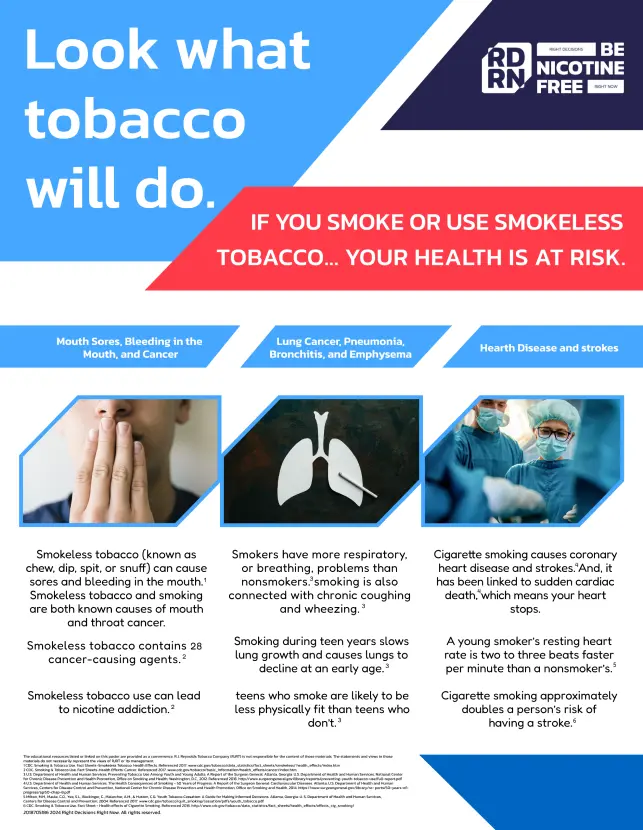
Click to enlarge photo FOLLOW-UP ACTIVITY
Read and think about the facts on this poster. Knowing this information and the health consequences you learned about on the previous pages, why do you think some people risk using tobacco?
ACTIVITY 3: Follow-Up Activity
Click to enlarge photo FOLLOW-UP ACTIVITY
Read and think about the facts on this poster. Knowing this information and the health consequences you learned about on the previous pages, why do you think some people risk using tobacco?
ACTIVITY 3: Follow-Up Activity
POSTER
- MESSAGE
- TOBACCO AND NICOTINE-RELATED PROBLEMS:

- Be tobacco free
- Why? Don’t smoke!
- See what smoking can do?!
- hardening of the arteries
- stained teeth
- pneumonia
- bronchitis
- nicotine addiction
- cancer of the pharynx (mouth and throat)
- heart disease
- gum disease
- phlegm production
- emphysema
- wheezing
- less physical fitness than people their age who don’t smoke
- cancer of the esophagus
- shortness of breath
- kidney cancer
- cancer of the pancreas
- coughing
- respiratory (breathing) problems
- cancer of the larynx (voice box)
- bad breath
- stroke
- lung cancer
- stinky clothes
- cataracts (which cause blindness)
- stomach cancer
- Be tobacco and nicotine free
- bladder cancer
- stinky hair
- Nicotine addiction