SURVEY COMPLETE!
Grades: grade-7
ACTIVITY 1: Tobacco Survey
ACTIVITY 1: Tobacco Survey
ACTIVITY 1: Tobacco and Nicotine Use – The Health Consequences
ACTIVITY 1: Tobacco and Nicotine Use – The Health Consequences
This survey asks you questions about tobacco and nicotine products, including cigarettes, vapes, smokeless tobacco and nicotine pouches. Maybe you don't know much about tobacco or nicotine products, or maybe you know someone who uses it? Just answer based on what you think. Answer as honestly as you can. If you do not want to answer a question, you can skip it. This survey is anonymous!
If you need to print this page, click "Print" before you click "Submit." Then, close the print window and click "Submit" to send your anonymous responses and see a final question.
Activity 7: Facing Tough Situations
Activity 7: Facing Tough Situations
How Friends Fit In (Interpersonal Skills)
In this section, students explore their relationships with others. The activities focus on peer relationships and how peer pressure, influence, and acceptance affect their lives. There are also activities on refusal skills to help equip students with strategies for saying "no".

SKILLS: Refusal Skills

Suggested Time Consideration: 40 mins
RATIONALE
It can be uncomfortable for students to reject pressure from friends (or from within) to do something they don’t want to do.
GETTING STARTED
Ask students to share examples about when they might have found themselves in uncomfortable situations, and how they managed to get out of them. Then, share the digital activity link below with your students. Review the suggestions for saying “no” to tobacco and nicotine, and display the poster that provides refusal tips while doing this activity. You’ll find the poster link in the “Activity Resources” section.
TALKING ABOUT IT
Have students work in groups for the “Act It Out!” exercise. Select some groups to act out the scenarios for the class. Ask the rest of the class which refusal techniques might work best. Discuss the possible consequences that might ensue from the different techniques.
WRAPPING UP
In discussion, get students to talk about which refusal techniques work better than others. Explain that in order to choose the best technique for them, they need to feel comfortable with it. They also need to consider whom they are refusing and how that person will receive the refusal. (Is this someone who responds well to humor? to confrontation? to politeness?) Get students to talk about the usefulness of practicing these sorts of strategies ahead of time so they are comfortable using them.
LAUNCH ACTIVITY
GO!Activity Resources
ACTIVITY 10: It’s Decision Time!
ACTIVITY 10: It’s Decision Time!
How I Am (Intrapersonal Skills)
This section has students look at how they act, feel, and think. Topics covered include self-esteem, social image, decision-making skills, and personal values (what is important to each student). The activities are designed to provide students with a chance to practice decision making and to empower them to make healthy choices.
SKILLS: Decision Making
Suggested Time Consideration: 30 mins
RATIONALE
Since the types of decisions students make change as they mature, this activity reviews the six steps outlined in the previous grades and has students evaluate three decisions they made recently so that they can assess their own decision-making style. (See the Overview Booklet for additional information about decision making that you can share with your students.) Students will also have the opportunity to make decisions about two hypothetical situations in a “Choices and Consequences” type of activity in the “You Decide!” section of the exercise. The “You Decide!” material is designed to be presented on an interactive whiteboard; alternately, students may complete this section in pairs or small groups.
GETTING STARTED
Share the digital activity link with your students, and ask them to list complex decisions they have made. They should work independently to describe their decisions and answer the questions about the process they go through when making them. Ask students to stop after they answer the question, “How do you make decisions when you feel stressed?”
TALKING ABOUT IT
Ask for volunteers to share their process with the class. In the discussion, get them to talk about whether they went through all the steps involved, whether they focused on some steps more than others, what sorts of factors influenced their decisions, and how/if stress plays a role in decision making. Also ask them to describe how they felt about the decisions they ultimately made.
Let students know that it can be helpful to know how we make decisions so that we can make the right decisions for ourselves.
WRAPPING UP
Present the “You Decide!” section of the activity on an interactive whiteboard, or have students complete it in pairs or groups. Tell students that in this case, if they make a poor decision, they’ll have the opportunity to go back to the beginning and start over—but that doesn’t always happen in real life.
If you present this section on a whiteboard, ask students questions about their choices and decisions as they make them. If students complete the exercise in pairs or groups, reconvene when they’ve finished to go over the students’ choices and decisions.
Encourage students to keep in mind the importance of evaluating options and consequences before they make a decision since they will have to deal with the results of their decisions—both the positive and the negative.
Use the supplemental “Surprise Chat” video to complement this activity.
LAUNCH ACTIVITY
GO!Activity Resources
ACTIVITY 9: My Perception!
ACTIVITY 9: My Perception!
How I Am (Intrapersonal Skills)
This section has students look at how they act, feel, and think. Topics covered include self-esteem, social image, decision-making skills, and personal values (what is important to each student). The activities are designed to provide students with a chance to practice decision making and to empower them to make healthy choices.
SKILLS: Building Self-Esteem / Understanding Personal Values
Suggested Time Consideration: 25 mins
RATIONALE
One predictor in the experimentation and escalation phases of tobacco and nicotine uptake is self-image—some adolescents turn to smoking or vaping because they think it will give them a better image.4 Low self-esteem is another factor that influences a young person’s decision to use tobacco and nicotine.
GETTING STARTED
To start this activity, ask students to brainstorm words or phrases that come to mind when they think of people using tobacco or nicotine. Explain that youth smoking rates among middle and high school students have declined over the past decade, but e-cigarette use is on the rise.5
When a comment reflecting the perception that smoking or vaping makes people look “cool” is raised, challenge students to explain why. Ask them to provide specific instances to support their notion that it looks cool. Chances are that any student thinking it looks cool will point to media representation. Ask these students:
Would the person be cool even if he or she did not smoke or vape?
What other characteristics make the person cool?
Do characters tend to hold cigarettes or vapes more often than smoke them? (It may be more common to see them holding cigarettes or vapes than inhaling or spitting tobacco, since these actions are usually less appealing to see.)
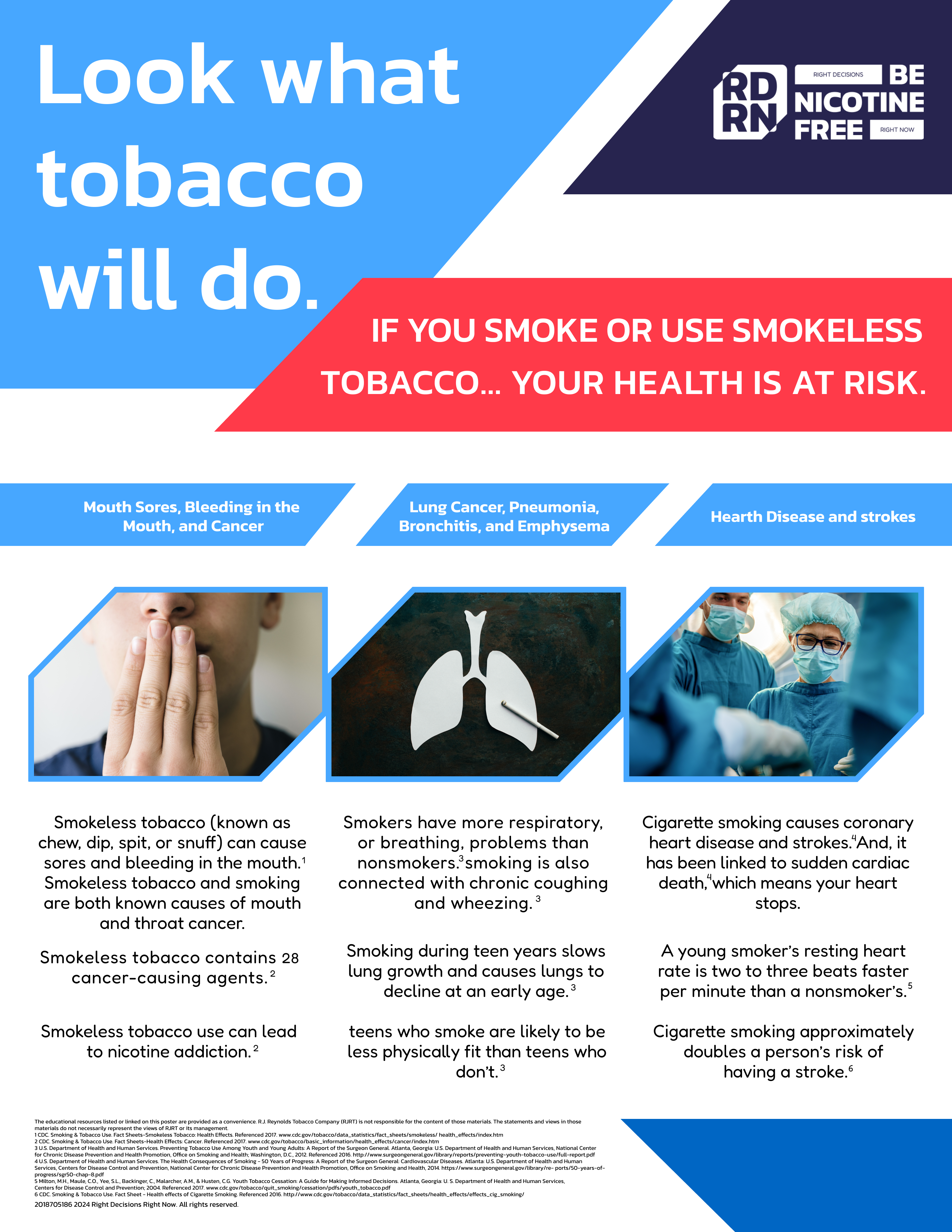
Spend time discussing how important “image” should be, especially when there is a difference between image and reality. Remind students of the health consequences of tobacco and nicotine use, and show them the poster with the images depicting these health issues. The poster is included in the “Activity Resources” section. There is nothing cool about these pictures.
For additional resources related to media representation, see the resource section in the Overview Booklet.
In this exercise, students will examine how they see themselves and the image that they want to portray. Share the digital activity link. Students will select and/or type 10 adjectives that they feel are self-descriptive. Then, they will look at an illustration of young people using tobacco and nicotine and select and/or type adjectives to describe their perception of the characters.
TALKING ABOUT IT
Once their lists are completed, students should compare them. Create two columns on the board with the headers “Us” and “The Characters.” Ask for volunteers to share adjectives and write them under each column. If you feel your students might be reticent to share their lists, you can suggest adjectives for the “Us” column.
Remind students that perceptions are subjective. Encourage them to talk about what they might have learned about themselves and about how others see them. Then move the conversation in the direction of what constitutes a positive self-image and raise the issue of how some people begin using tobacco or nicotine simply because of how they think it makes them look.
WRAPPING UP
Refer back to the words on the board. If your students have a positive perception of the characters in the illustration, ask them to explain why. See if some students a) think it looks cool to smoke/vape, b) think it looks cool but isn’t worth the risk, or c) think it looks ridiculous. Try to bring the conversation around to a discussion of how, when it comes to tobacco and nicotine, there aren’t any “positive” images.
To emphasize the point, display the poster depicting the health consequences of tobacco and nicotine use. Refer to the list of words and tell students, “Keep in mind that the pictures and facts on the poster are reality.”
SOURCES
4 U.S. Department of Health and Human Services. Preventing Tobacco Use Among Youth and Young Adults: A Report of the Surgeon General. Atlanta, Georgia: U.S. Department of Health and Human Services, National Center for Chronic Disease Prevention and Health Promotion, Office on Smoking and Health; Washington, D.C., 2012. Referenced 2023. http://www.surgeongeneral.gov/library/reports/preventing-youth-tobacco-use/full-report.pdf
LAUNCH ACTIVITY
GO!Activity Resources
Activity 8: Let Me Illustrate
Activity 8: Let Me Illustrate
How Friends Fit In (Interpersonal Skills)
In this section, students explore their relationships with others. The activities focus on peer relationships and how peer pressure, influence, and acceptance affect their lives. There are also activities on refusal skills to help equip students with strategies for saying "no".
SKILLS: Analytical Reasoning / Researching and Creating Reports
Suggested Time Consideration: 25 mins
RATIONALE
In this activity, students will demonstrate what they’ve learned about the health consequences of tobacco and nicotine use and the refusal skills presented in previous activities to create illustrations about saying “no.” This will help you reinforce the message and assess students’ understanding of the material.
GETTING STARTED
Ask students to share examples about when they might have found themselves in uncomfortable situations, and how they managed to get out of them. Then, share the digital activity link below with your students. Review the suggestions for saying “no” to tobacco and nicotine, and display the poster that provides refusal tips while doing this activity. You’ll find the poster link in the “Activity Resources” section.
TALKING ABOUT IT
When students have completed the activity, have them present and explain their illustrations to the class.
For the “Draw It!” section, brainstorm topics with your students to get them thinking about other common situations they encounter to which they can apply the refusal skills they’ve learned.
WRAPPING UP
Have students share their “Draw It!” illustrations and then post them on a bulletin board under the heading “When Saying ‘No” Is the Way to Go.”
FOLLOW-UP ACTIVITY
Students need to be equipped with skills to refuse offers to smoke or vape or use other tobacco and nicotine products. They should also be aware of policies, rules, and laws that relate to tobacco and nicotine use and possession in your area.
Have your students work in groups to research and report back to the class on the following:
The school’s smoke-free or vape-free policy: Students should describe the policy, when it was implemented, and what the consequences are for breaking the policy. If your school does not have a policy, students can find out what can be done to implement one.
State and federal laws regarding tobacco or nicotine product possession and/or use by minors: Students should prepare oral presentations to convey their findings.
LAUNCH ACTIVITY
GO!UNIT QUIZ: Student Assessment
UNIT QUIZ: Student Assessment
Unit Quiz
Should be used after students complete the activities and lessons. It is designed to help you assess their understanding of the content. Students will work in small groups to determine answers to True/False, Choices & Consequences, and Fill-in-the-Blanks questions.
SKILLS: Comprehending / Analyzing Data
Suggested Time Consideration: 25 mins
RATIONALE
The quiz will help you assess your students’ understanding of the content of the “Right Decisions, Right Now: Be Nicotine Free” program.
GETTING STARTED
When you are done with the lessons and your students have completed the activities, have your class break into small groups and face the interactive whiteboard. You may also opt to project this onto a screen from your computer.
Display the digital activity link to the main page of the quiz on the interactive whiteboard or projector screen.
In this quiz, there are three categories: “True/False”, “Multiple Choice”, and “Fill in the Blanks”. In each category, there are five questions. There is also one “Daily Double” question (worth twice the points) and a “Final Question”.
Decide which group of students will begin the game. Then, let them select a category and a number value. For example, they may select “True/False” for 200, or “Fill in the Blanks” for 400. They need not go in order.
When students select a category and number value, click on it from your computer or at the interactive whiteboard to display the question. Click on the “Answer” button to display the answer. Do not display the answer until the correct answer has been given by a team or all groups have taken a turn. Review the answers first (in the “Answers” section) and consider printing them out for easy reference (see the “Materials” section). To go back to the main quiz screen after each question is answered correctly, click on the “Home” button at the bottom of the screen.
Pose each question to the entire class and determine who will get to answer first based on speed of response. Alternately or in addition, you may wish to ask teams to write down their complete answers before raising their hand to respond. If you do so, you may opt to award points to all teams that get the correct answer, regardless of response time. In this case, have teams take turns selecting categories and point values, as well as answering. If you choose to determine who gets to answer first and earn points based on speed of response, follow these guidelines: if someone in a group raises their hand first, with the correct answer to the question in the category, they will then win the points and get to choose the next category and number value. If they raise their hand first but get the answer wrong, you would then allow the other teams to answer, with the order determined by how quickly they responded. The team with the correct answer, or the team that had the last correct answer, will choose the next category and point value. This will continue throughout the game.
Request that a student volunteer keep track of points for each team on the chalkboard or on a piece of paper. When a team gets a correct answer, they earn the category value. When they get an incorrect answer, the point value of the question is deducted. Alternately, you may opt to only add and not deduct points.
For the “Final Question” round, tell the class that the category is “Health Consequences” before clicking on the button to display the final question. Based on the category, each group should write down a point value they are willing to risk. The scorekeeper should share the team scores prior to this point so groups can make an informed decision.
Teams with the correct answer will have the point value they risked added to their score. Teams with an incorrect answer will have it deducted from their score, or simply not added.
TALKING ABOUT IT
Emphasize that the point of the Unit Quiz is for students to have an opportunity to share what they’ve learned about being tobacco free.
Note the questions students struggle with most and consider discussing them with students after the quiz.
ANSWERS
| Points | Question | Answer |
|---|---|---|
| Questions/Prompts in “True/False” Category | ||
| (100) | Most middle schoolers are not current cigarette smokers or vapers. | What is “True”? |
| (200) | Nicotine addiction can occur after as few as 100 cigarettes/vapes | What is “True”? |
| (300) | Using smokeless tobacco does not cause health consequences. | What is “False”? |
| (400) | Nicotine does not affect or change the brain the same way heroin and cocaine do. | What is “False”? |
| (500) | The younger a person is when he or she starts to smoke cigarettes or vape, the more likely he or she is to become addicted to nicotine. | What is “True”? |
| Questions/Prompts and Answers in “Multiple Choice” Category | ||
| (100) | Young people who smoke cigarettes or vape can experience_______. a) shortness of breath b) coughing and wheezing c) nicotine addiction d) all of the above | d |
| (200) | What is nicotine? a) a neurotransmitter b) a neuron c) a drug found in tobacco leaves d) a form of glucose found in tobacco leaves | c |
| (300) | Which statements are the most accurate? a) Smoking cigarettes can damage your lungs. b) Vaping can affect your brain and your ability to pay attention. c) Smoking cigarettes can damage nearly every organ in your body. d) Smoking or vaping is only harmful to people who have smoked for a long time. | a, b and c |
| (400) | Half the effects of nicotine are gone in _______. a) 35 minutes b) 40 minutes c) 60 minutes d) 90 minutes | b |
| (500) | Without nicotine, a smoker can feel ___________. a) cold and sad b) energetic and thirsty c) irritable and depressed d) happy and alert | c |
| Questions/Prompts and Answers in “Fill in the Blanks” Category | ||
| (100) | Three health consequences of tobacco use are ___________, _____________, and __________. | What are: (any three of the following would be correct)
|
| (200) | (Double Your Points—Worth 400 Points!) Three nicotine withdrawal symptoms are ____________, ____________ and ___________. | What are: (any two of the following would be correct.)
|
| (300) | The difference between peer pressure and peer influence is ______________________. An example of peer pressure is ___________________. An example of peer influence is ________________. | What are:
|
| (400) | When making a decision, three things to consider include ___________, ______________, and _________. | What are:
|
| (500) | You want to be tobacco and nicotine free. What are three ways you could say “no” to a friend who offers you a cigarette or vape? | What are: (any three of the following would be correct.)
|
| Prompt and Answers for the Final Question | ||
| TBD by Students | List three types of cancer caused by smoking. | What are: any three of the following would be correct: pharynx (mouth and throat), larynx (voice box), esophagus, lungs, stomach, pancreas, kidney, bladder |
Teachers, please note that students may come up with other types of cancer they believe are caused by smoking. Direct students to some of the online resources included in the program footnotes to have them check to see if they are correct.
WRAPPING UP
End the lesson with a class discussion about decisions students make to be healthy and positive. Ask them what it means and why they think it is important to have a healthy, active lifestyle and good eating habits. Ask them how using tobacco or nicotine products such as vapes or smokeless tobacco would negatively affect a healthy lifestyle.
For a complete list of health consequences related to tobacco use, visit www.cdc.gov/tobacco.
For more information about the health impact of using e-cigarettes, visit: Know the Risks of E-cigarettes for Young People | Know the Risks: E-cigarettes & Young People | U.S. Surgeon General’s Report
INTERACTIVE WHITEBOARD POWERPOINT
For your convenience, we have created this same activity in two formats. The optimized interactive whiteboard PowerPoint includes additional audio and visual effects to engage your students. Click here to download the PowerPoint. You’ll also find it in the “Materials” section below.
LAUNCH ACTIVITY
GO!Activity Resources
ACTIVITY 6: Thinking Your Way to Good Decisions
ACTIVITY 6: Thinking Your Way to Good Decisions
How Friends Fit In (Interpersonal Skills)
In this section, students explore their relationships with others. The activities focus on peer relationships and how peer pressure, influence, and acceptance affect their lives. There are also activities on refusal skills to help equip students with strategies for saying "no".
SKILLS: Refusal skills
Suggested Time Consideration: 25 mins
RATIONALE
This activity is designed to help students use their knowledge of peer pressure and influence (or the desire for acceptance) to reassess their thoughts and preconceptions about what happens in peer groups. You may wish to have students complete the activity in small groups; alternately, consider presenting the activity on an interactive whiteboard and completing it as a class.
GETTING STARTED
If students will be completing the activity in small groups, organize them into groups and share the digital activity link below with each group. Alternately, present the activity to the class as a whole.
Ask students to read the first scenario and talk among themselves about what they think might happen. They should use the questions listed in the activity as a framework for discussion.
TALKING ABOUT IT
Discuss each scenario separately. In the first one, get the students to talk about why they might get tired of their friend asking to copy homework. Ask if there is a part of them that does want to give him the homework, and if so, why? Ask students:
- Is it possible that the decision not to share the homework might change the relationship?
- Is it possible that it won’t change the relationship?
- Would you be ready to live with the consequences of your action?
Wrap up the discussion by talking about how relationships are bound to have conflicts and disappointments, and that these might generate some anger or hurt feelings, but in most cases these feelings subside. Talk about how we can value our relationships enough to accept the good with the bad.
In the second scenario, have the students examine whether or not they would feel as though they would be treated differently by their friends.
- Will you still be welcomed in the home after school?
- Do you want to be there?
- Do you have any feelings about your friend’s smoking?
WRAPPING UP
To conclude, ask students to complete the “You Decide!” portion of the activity. Then, zero in on the decision not to smoke. Explain that in some cases, people continue to smoke even if they initially don’t like it. Reinforce the wisdom of the decision not to smoke, and how it reflects priorities. (For example, “It’s more important not to do something I don’t like than it is to be accepted in my peer group.”)
LAUNCH ACTIVITY
GO!ACTIVITY 5: What’s Important to Me!
ACTIVITY 5: What’s Important to Me!
How Friends Fit In (Interpersonal Skills)
In this section, students explore their relationships with others. The activities focus on peer relationships and how peer pressure, influence, and acceptance affect their lives. There are also activities on refusal skills to help equip students with strategies for saying "no".
SKILLS: Understanding Peer Relationships / Dealing With Peer Pressure
Suggested Time Consideration: 25 mins
RATIONALE
Research shows that peer influence, or a child’s internal desire to be accepted, is a stronger influence of tobacco and nicotine products or nicotine experimentation than overt peer pressure.16 Many young people will try tobacco and nicotine products because of the kind of reaction they think they will get from their peers, even if they don’t feel pressured by those peers.
This activity will help students evaluate their need for acceptance or approval by their peers, as well as the need to be themselves.
GETTING STARTED
Share the activity link below with your class. Then, review the information provided in the activity. Ask your health teacher or school nurse to join you for the activity. Have a dictionary or a health textbook on hand so students can look up unfamiliar terms and share them with the class.
TALKING ABOUT IT
When students have finished, ask them to read the following scenario silently as you read it aloud. Students will see it on screen.
Tyrell is walking home from school with a group of friends. In the past few weeks, some of them have started vaping on the way home. This goes on for several days, after which most of Tyrell’s friends have picked up the behavior. One day, Tyrell reaches into his pocket, pulls out a vape, and starts vaping.
Tell students to answer the questions following the scenario. Then, lead them in a discussion of why Tyrell did what he did. Ask students:
- Why do you think it was important to Tyrell that he try vaping (nicotine)?
- What were his motivations to use nicotine?
- Do you think he would have vaped if he had not been in that environment?
- Do you think things changed for him (or not) in the group once he adopted this behavior?
WRAPPING UP
To wrap up, get the students to talk about priorities—what is most important to them—and ask them how being tobacco and nicotine free reflects their priorities. Next, ask them how Tyrell might have been able to use his own “inventory of priorities” to think through his decision and choose to be tobacco and nicotine free.
LAUNCH ACTIVITY
GO!ACTIVITY 4: Peer Pressure & Influence - Do Your Friends Affect Your Decisions?
ACTIVITY 4: Peer Pressure & Influence - Do Your Friends Affect Your Decisions?
How Friends Fit In (Interpersonal Skills)
In this section, students explore their relationships with others. The activities focus on peer relationships and how peer pressure, influence, and acceptance affect their lives. There are also activities on refusal skills to help equip students with strategies for saying "no".
SKILLS: Understanding Peer Relationships / Dealing With Peer Pressure
Suggested Time Consideration: 30 mins
RATIONALE
It’s important for your students to understand that no one enjoys being excluded by peers or doing things that will make peers like them any less. However, we can and should make decisions based on what we think is best for us, rather than on what we want others to think of us.
GETTING STARTED
Before starting the activity, remind your students that peer pressure occurs when the words or actions of our friends push us to do something we don’t want to do. Peer influence is the urge we sometimes feel to do something other people are doing because we want them to think highly of us. (See the Overview Booklet for additional information about peer pressure and influence.)
Read the following examples and comments to your students:
- Peer influence and peer pressure can have positive effects. For example, one of the boys on the football team is lazy, but when he sees all the other boys lifting weights to get ready for the upcoming season, he joins in. His decision is not based on his desire to do the work but on his desire to fit in with his teammates.
- Peer pressure can have negative effects as well. When a group of students that we want to like us all decide to cut math class and they invite us to join them, we might do so. We don’t really want to miss the class, and we wouldn’t cut it if no one else did, but we decide to go along because we like the approval we receive from the others in the group. Explain to students that when they understand peer pressure, they don’t have to give in to it. For example, we can decide that we will go to math class, even if it costs us some popularity with the others.
In this exercise you will give your students four situations, one at a time. They will determine whether each situation is an example of peer influence or peer pressure and consider how the person being influenced or pressured might be feeling. For each situation, they will also complete a “choices and consequences” type of activity that will give them an opportunity to decide what they would do. In this case, students may go back and change their minds—but remind them they can’t always do that in real life. You may opt to present this activity on an interactive whiteboard or have students complete it individually. Share the digital activity link below with your students. Then, read through the instructional text and first situation with students to help them get started.
TALKING ABOUT IT
Ask students to pause after they read each situation and wait for your instructions. For each situation, say to students:
- Put yourself in the character’s position. What sort of conflicting feelings might the characters have?
- What choices does the character have?
- Do you think you would give in to the pressure or influence in this situation?
- Have you ever been in this situation or a similar one?
Answers:
Answers about the character’s feelings and the choices students make in each situation will vary. The situations are examples of:
- peer pressure
- peer pressure
- peer influence
- peer pressure
After discussing the situations, break the class down into small groups and ask each group to come up with two scenarios. In one, have them devise an example of positive peer influence. Then have them devise an example involving tobacco in which negative peer influence or pressure is felt. Each group should act out its scenarios for the rest of the class.
WRAPPING UP
To wrap up, talk about the difference between influence and pressure (or coercion), emphasizing the fact that—whether positive or negative—friends and peers can only encourage a certain behavior. A person is ultimately responsible for his or her decisions and the consequences.
Use the supplemental “Eggin’” video to complement this section. complement this section.