Skip to content

ACTIVITY 3: Tobacco & Nicotine Addiction

ACTIVITY 3: Tobacco & Nicotine Addiction

Keeping Healthy

This section includes a survey to determine students' perceptions about tobacco and nicotine, their understanding of its effects and their experience with it. In addition, it includes activities to educate students about the health consequences of smoking, vaping and use of other tobacco and nicotine products.

SKILLS

SKILLS: Assessing Risks and Consequences

Suggested Time Consideration

Suggested Time Consideration: 25 mins

RATIONALE

As mentioned in the teacher’s instructions for Activities 1 and 2, adolescents may not understand the nature of tobacco and nicotine addiction. This activity will explain what nicotine is and how it affects the body so that students understand the concept of addiction as they make their decision to be tobacco and nicotine free.

GETTING STARTED

To introduce this activity, ask students to define “addiction.” Write their thoughts on the board or chart paper. Students might give you examples of things people might be addicted to, such as drugs, alcohol, or tobacco and nicotine. Encourage them to define the term. Then, have a student provide the dictionary definition of “addiction.” 

Explain to your students that they are going to read about tobacco and nicotine addiction. Then, share the digital activity link below with your students. Have them complete the activity, including questions and answers, and then review the answers together. You may wish to present it on an interactive whiteboard or have students go directly to the activity on their computers. Have them work in groups to assess the risks and health consequences for the smoking/vaping scenario. Note that they may navigate back and forth between the activity screens by clicking the “Page” tabs at the bottom of the activity. 

LAUNCH ACTIVITY
TALKING ABOUT IT

Answers 
1) TRUE. Nicotine is a drug. 
2) FALSE. In order to be “True,” the statement should say: The adrenaline (or epinephrine) released by the body after absorbing nicotine stimulates the body and causes an increase in blood pressure, respiration, and heart rate. 
3) FALSE. In order to be “True,” the statement should say: Most smokers or vapers use tobacco regularly because they are addicted to nicotine. 
4) FALSE. In order to be “True,” the statement should say: Each year, nearly 35 million smokers want to quit. 
5) TRUE. Nicotine causes the same changes in the brain as heroin and cocaine. 
6) TRUE. Without nicotine, a smoker/vaper can feel irritable and depressed. 

After reviewing the answers together, share the following additional facts with your class: 

  • Studies have shown that addiction can occur after smoking/vaping as few as 100 cigarettes or vapes. And some young people have shown symptoms of dependence within the first few weeks of using a nicotine product like a cigarette or vape.9
  • Tobacco smoke contains more than 4,000 chemicals. The most dangerous chemicals in cigarette smoke, besides nicotine, are tar and carbon monoxide. Tar causes lung cancer, emphysema, and bronchial disease. Carbon monoxide causes heart problems.10
  • In 2021, 65.3% of youth (middle and high school students) who currently used tobacco products reported that they were seriously thinking about quitting the use of all tobacco products.11
  • The younger people are when they begin smoking cigarettes or vaping, the more likely they are to become strongly addicted to nicotine.4
  • Young people who try to quit  cigarettes or vapes suffer from the same nicotine withdrawal symptoms as adults.4
  • Cigarette smoking is responsible for more than 480,000 deaths per year in the U.S.—approximately one out of every five deaths.12 This fact from the CDC is very real. Even more startling, based on current smoking patterns, an estimated 25 million Americans alive today will die prematurely from smoking-related illnesses.12
WRAPPING UP

To wrap up the activity and reiterate the health consequences of tobacco and nicotine use and the addictive nature of nicotine, discuss the warning labels that appear on tobacco and nicotine products. 

Explain to your students that the U.S. Surgeon General serves as the head of the United States Public Health Service and is the leading spokesperson on such matters for the U.S. government. There are specific health warnings placed on cigarette packages and advertisements on a rotating basis.13 Display the following warnings for your students to see, or write them on the board: 

  • SURGEON GENERAL’S WARNING: Smoking Causes Lung Cancer, Heart Disease, Emphysema, and May Complicate Pregnancy.
  • SURGEON GENERAL’S WARNING: Quitting Smoking Now Greatly Reduces Serious Risks to Your Health.
  • SURGEON GENERAL’S WARNING: Smoking by Pregnant Women May Result in Fetal Injury, Premature Birth, and Low Birth Weight.
  • SURGEON GENERAL’S WARNING: Cigarette Smoke Contains Carbon Monoxide. 

The Comprehensive Smokeless Tobacco Health Education Act of 1986, as amended, requires that there be one of the following warning labels on smokeless tobacco packaging and advertisements. They are: 

  • WARNING: This product can cause mouth cancer.
  • WARNING: This product can cause gum disease and tooth loss.
  • WARNING: This product is not a safe alternative to cigarettes.
  • WARNING: Smokeless tobacco is addictive. 

Ask your students: 

  • Have you seen these warning labels before?
  • Were you aware that these health issues could result from tobacco and nicotine use?
  • Why do you think these labels are important?

Conclude by telling students that you hope their knowledge of these health risks and the addictive nature of nicotine will help them make the right decision to be tobacco and nicotine free. 

FOLLOW-UP ACTIVITY

As a group, brainstorm positive, healthy activities students can engage in as alternatives to using tobacco or nicotine. For example, they could exercise, paint, draw, sing, dance … the list is endless. 

SOURCES

4 U.S. Department of Health and Human Services. Preventing Tobacco Use Among Youth and Young Adults: A Report of the Surgeon General. Atlanta, Georgia: U.S. Department of Health and Human Services, National Center for Chronic Disease Prevention and Health Promotion, Office on Smoking and Health; Washington, D.C., 2012. Referenced 2017. http://www.surgeongeneral.gov/library/reports/preventing-youth-tobacco-use/full-report.pdf 

9 Milton, M.H., Maule, C.O., Yee, S.L., Backinger, C., Malarcher, A.M., Husten, C.G. Youth Tobacco Cessation: A Guide for Making Informed Decisions. Atlanta, Georgia: U. S. Department of Health and Human Services, Centers for Disease Control and Prevention; 2004. Referenced 2023.https://stacks.cdc.gov/view/cdc/11319/cdc_11319_DS1.pdf 

11 CDC. Smoking & Tobacco Use. Fact Sheet-Quitting Smoking. Referenced 2023. www.cdc.gov/tobacco/data_statistics/fact_sheets/cessation/quitting/index.htm

12 CDC. Smoking & Tobacco Use. Fact Sheet-Tobacco-Related Mortality. Referenced 2017. www.cdc.gov/tobacco/data_statistics/fact_sheets/health_effects/tobacco_related_mortality/index.htm

13 CDC. Smoking & Tobacco Use. History of the Surgeon General’s Reports on Smoking and Health. Referenced 2017. www.cdc.gov/tobacco/data_statistics/sgr/history/ 

LAUNCH ACTIVITY

GO!

ACTIVITY 2:  Tobacco & Nicotine Use–The Health Consequences

ACTIVITY 2:  Tobacco & Nicotine Use–The Health Consequences

Keeping Healthy

This section includes a survey to determine students' perceptions about tobacco and nicotine, their understanding of its effects and their experience with it. In addition, it includes activities to educate students about the health consequences of smoking, vaping and use of other tobacco and nicotine products.

SKILLS

SKILLS: Assessing Risks and Consequences

Suggested Time Consideration

Suggested Time Consideration: 25 mins

RATIONALE

Young people often feel invincible. They may think smoking or vaping causes health problems for adults, but that those same health risks won’t apply to them. According to the CDC, “many children and adolescents do not understand the nature of tobacco addiction and are unaware of or underestimate the important health consequences of tobacco use.5 Therefore, they need to be reminded that health consequences of tobacco and nicotine use affect everyone. This activity outlines and explains some of the health consequences caused by cigarettes, vapes and smokeless tobacco. Knowing the facts may prevent students from experimenting or stop them if they’ve already tried tobacco or nicotine. 

The CDC reports each year that more deaths are caused by tobacco use than by all deaths from motor vehicle injuries, illegal drug use, alcohol use, human immunodeficiency virus (HIV), suicides, and murders combined.7 Share this statistic with your students.

Ask your health teacher or school nurse to join you for this activity. Have a dictionary or health textbook on hand so students can look up unfamiliar terms and share them with the class.

GETTING STARTED

To introduce this activity, show your students the consequences of tobacco and nicotine use listed below. Display the list on an interactive whiteboard or with a projector, or write the terms on the board.4,8

Tobacco-Related Health Consequences

  • Halitosis (bad breath)
  • Throat cancer
  • Shortness of breath
  • Kidney cancer
  • Stained teeth
  • Gum disease
  • Cracked lips
  • Stroke
  • Mouth sores/bleeding in the mouth
  • Heart disease
  • Coughing/wheezing
  • Emphysema
  • Smelly hair (non-health related)
  • Lung cancer
  • Oral cancer
  • Nicotine addiction
  • Tooth loss 


Vaping and Nicotine Use Side Effects 

  • Nicotine addiction
  • Mood disorders
  • Permanent lowering of impulse control
  • Impact to attention and learning

Ask the students to review the list. Use the internet to define any unfamiliar terms. Then, ask students which issues on the board they believe are health consequences of tobacco use. Check each one the students suggest. Next, tell them that all of the items on the list are health consequences of tobacco use—and they are real. Some students might be concerned about consequences such as bad breath and the smell, while others may be more concerned about the diseases. 

Share the activity link with your class or open the activity on your interactive whiteboard. Click the thumbnail below for the link. Then, review the information provided in the activity. 

TALKING ABOUT IT 

After students complete the activity, take a class poll to see which of the health consequences students were familiar with and which ones they were not. They may be surprised to learn how quickly a young person can be affected by using tobacco and nicotine. 

WRAPPING UP

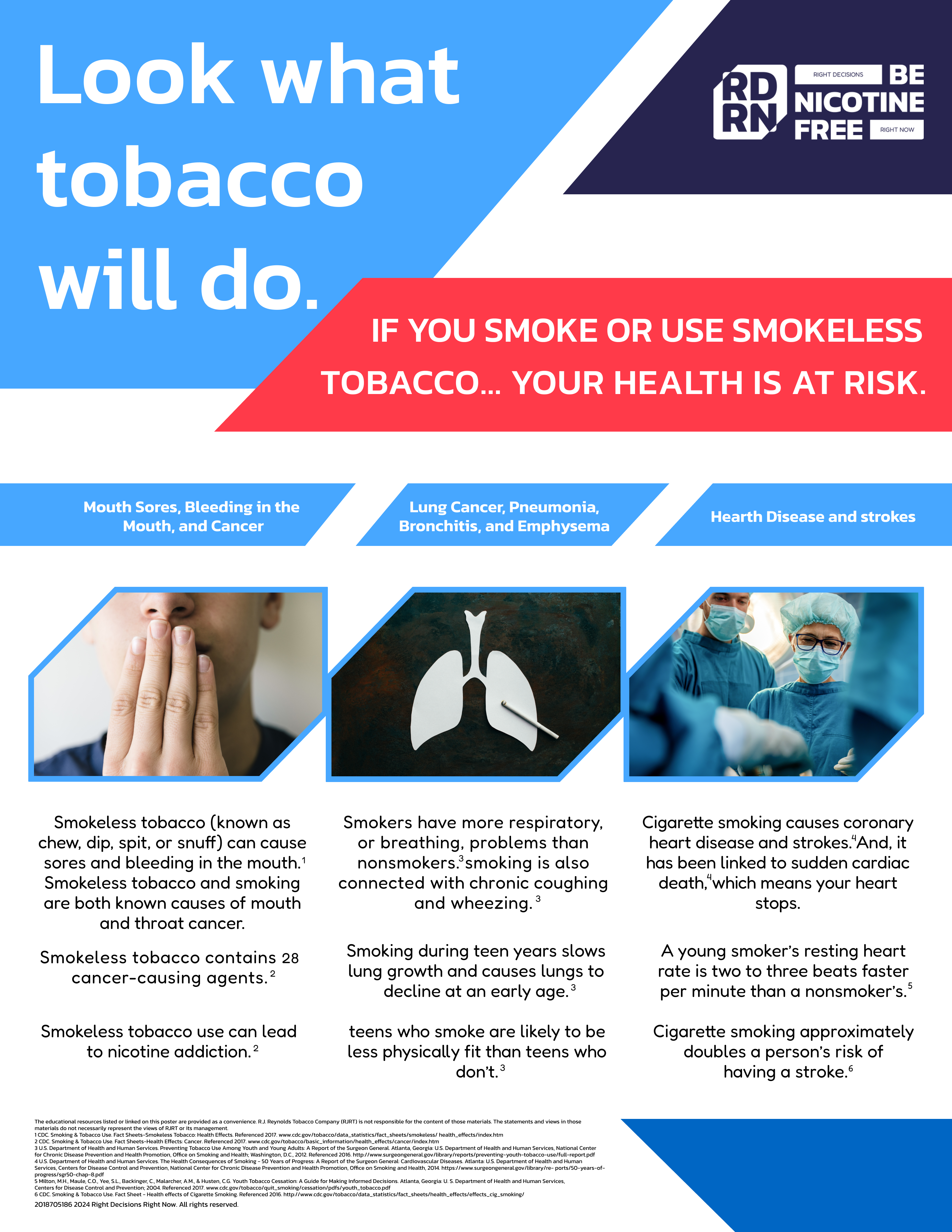
Before completing this activity, display the health consequences poster, “Look What Tobacco Will Do.” It is included in the “Activity Resources” section below. Read the facts with your students. Remind them that these are real issues that affect people who use tobacco and nicotine. Deciding to be tobacco and nicotine free will help them stay healthy.

As a class, visit the CDC’s website for additional information on health consequences. 

FOLLOW-UP ACTIVITY

Use the supplemental “Totally Caught” video, in the “Materials” section below, to complement this section. 

Students will discover this fact at the completion of Activity Two: Cigarette smoking is responsible for about one in five deaths in the U.S. per year.7 Have students work in teams to research this fact and prepare presentations or reports to encourage people to be tobacco and nicotine free. Along with their presentations or reports, have the students create a digital poster representing what they’ve learned about tobacco and nicotine and its health consequences. The materials for the digital poster are provided below. 

To create their presentations or reports, students might use photos or images, Internet resources, books, or interviews with smokers who quit as their resources, along with their digital posters. They will then create a slideshow, handouts for their peers, or any presentation method of their choice to accompany their digital posters and demonstrate the health consequences of tobacco and nicotine use that generate the statistic above. 

Determine a timeframe that is appropriate for your group. Let students get creative and use whatever aids they find most effective to do their reports/presentations. Schedule each pair/group for a different day during the unit to present its findings so your students have enough time to prepare their projects. Invite other classes in to see the presentations. 

LAUNCH ACTIVITY
SOURCES

4 U.S. Department of Health and Human Services. Preventing Tobacco Use Among Youth and Young Adults: A Report of the Surgeon General. Atlanta, Georgia: U.S. Department of Health and Human Services, National Center for Chronic Disease Prevention and Health Promotion, Office on Smoking and Health; Washington, D.C., 2012. Referenced 2023. http://www.surgeongeneral.gov/library/reports/preventing-youth-tobacco-use/full-report.pdf 

5  CDC. Guidelines for School Health Programs to Prevent Tobacco Use and Addiction. MMWR 1994; Vol. 43, No. RR-2; 1-18. Referenced 2023. http://www.cdc.gov/mmwr/PDF/RR/RR4302.pdf 

7 CDC. Smoking & Tobacco Use. Fact Sheet—Health Effects of Cigarette Smoking. Referenced 2017. http://www.cdc.gov/tobacco/data_statistics/fact_sheets/health_effects/effects_cig_smoking/index.htm 

8 NIDA for Teens. (2016, May). Drug Facts: Tobacco, Nicotine, & E-Cigarettes. Referenced 2023. https://teens.drugabuse.gov/drug-facts/tobacco-nicotine-e-cigarettes 

9  https://e-cigarettes.surgeongeneral.gov knowtherisks.html#:~:text=Youth%20and%20young%20adults%20are,permanent%20lowering%20of%20impulse%20control

LAUNCH ACTIVITY

GO!

ACTIVITY 1:  Take a Tobacco and Nicotine Survey 

ACTIVITY 1:  Take a Tobacco and Nicotine Survey 

SKILLS

SKILLS: Assessing Risks and Consequences

Suggested Time Consideration

Suggested Time Consideration: 25 mins

RDRN Activity Page

This student survey is designed to help you launch your prevention unit and generate class discussion about the health impact of tobacco and nicotine. But first, be sure to read the Overview Booklet for Grades 5–9 . It provides all the information you need to know to successfully implement this material.

Survey, Parts One and Two

Part One of the activity asks students about their experiences with tobacco and nicotine. It consists of questions taken from the CDC’s National Youth Tobacco Survey (NYTS) 2023 Questionnaire — a survey that can be used to estimate current use of tobacco products and selected indicators related to tobacco use among U.S. middle school and high school students. These surveys are periodically done by the government to assess tobacco use. The complete survey and reports are available online here.

Part Two of the Survey includes open-ended questions that ask students what they think or know about the prevalence and health consequences of tobacco and nicotine use, quitting, and why young people use tobacco or nicotine products, including e-cigarettes/vapes, smokeless tobacco and nicotine pouches. Once you have completed all activities, please delete or dispose of all student surveys.

RATIONALE
Adolescents and young adults are uniquely susceptible to social and environmental influences to use tobacco and nicotine products like e-cigarettes (vapes) and smokeless tobacco. It’s a sensitive developmental period, with extraordinary brain changes and high levels of emotionality, impulsivity and risk-taking.1 During this time, they will get a lot of their information (or misinformation) from their friends, potentially causing them to make decisions they will later regret. Teaching students the health consequences of tobacco and nicotine use in this program is one important way to communicate the facts and help them make the decision to be tobacco and nicotine free. Since the survey asks students about their personal experience with tobacco and/or nicotine, it should be done independently and anonymously. Assure students that no personally identifying information will be included in the survey they email to you.
GETTING STARTED

Before starting the activity, ask your students:

  • What have you learned about tobacco and nicotine?
  • What/who has given you information about smoking, vaping or use of other tobacco and nicotine products? (e.g., television/media, magazines/books, parents/family members, teachers, peers/friends) 

Then, direct students to the online survey in the website by clicking “Launch Activity” below. We recommend emailing the link to your students, posting it on a class web page, projecting it on an interactive whiteboard, and/or writing it on a chalkboard.

Explain to your class that they are going to take a survey about tobacco and nicotine. Encourage them to answer the questions as honestly as they can. Let them know that the first eight questions ask them about their experience with tobacco and nicotine and are only going to be used by you to get a sense of what they have experienced. Tell them the survey will be entirely anonymous and no identifying information will be included in the responses they email to you. Inform students that once they have finished the survey, you will share some information with them related to Part Two. Explain that being informed is an important element of making the right decisions. Then, let students know that they will learn facts about tobacco and nicotine use and tips for coping with peer pressure in this unit, “Keeping Healthy.”

LAUNCH ACTIVITY
TALKING ABOUT IT

Once the survey is complete, share with your students the facts listed in the answer key part of the “Wrapping Up” section to dispel misperceptions they may have about tobacco and nicotine use and to reinforce the message that most young people don’t use tobacco or nicotine. Also, encourage students to volunteer answers during your discussion if they feel comfortable.

WRAPPING UP

Answers, part one
Answers will vary. Review the answers students provided for questions 1–8. This will give you a sense of your students’ experience with tobacco and nicotine, but it should not be shared with the students. 

ANSWERS, Part Two 
1–8. Explain to students that most young people do not smoke or vape. Only about 1 of every 100 middle school students (1.0%) reported that they had smoked cigarettes in the past 30 days, and 1 out of every 30 middle school students (3.3%) reported that they had used e-cigarettes/vapes in the past 30 days.2

Point out to students that the younger people are when they start smoking, the more likely they are to become addicted.

4. Ask students if they want to volunteer answers about why young people use tobacco. Note their answers on the board. Explain to students that some of the reasons young people try or start to use tobacco include:4, 3

They don’t feel good about themselves (low self-esteem and self-image). 
They don’t know about the health consequences of smokeless tobacco. 
They think lots of people smoke or vape (overestimating number of people who smoke/vape). 
They don’t realize that they can become addicted (not understanding the addictive potential of nicotine).

5. Ask students if they want to volunteer answers about why they think young people choose to be tobacco and nicotine free. Explain that some people may choose to be tobacco and nicotine free because:4, 5

Their friends don’t use tobacco or nicotine products. 
They know about the health consequences. 
They want to be tobacco and nicotine free.

6–7. Explain to students that some young people try tobacco because of a “lack of self-efficacy in the ability to refuse offers to use tobacco,”4 or they don’t know how to tell their friends they don’t want to try it. 

Explain to students that people their age are sometimes pressured to use tobacco or nicotine products, and that pressure can be difficult to handle. Let them know that in this unit, they are going to learn some ways to say “no” and cope with peer pressure so they can be tobacco and nicotine free.

If students volunteer stories, remind them not to use names. Listen to their concerns and explain to students that feeling pressure from friends happens, but that they will learn some ways to deal with the pressure.

8. Explain to students that there are health consequences related to tobacco use. According to the Surgeon General, symptoms such as coughing, shortness of breath, nausea, and phlegm production can develop in young people who smoke.4 Youth and young adults are also uniquely at risk for long-term, long-lasting effects of exposing their developing brains to nicotine. These risks include nicotine addiction, mood disorders, and permanent lowering of impulse control. Nicotine also changes the way synapses are formed, which can harm the parts of the brain that control attention and learning.4 Tell them that they will learn more about the health consequences in Activities 2 and 3. If students want to volunteer answers, write them on the board and then revisit the list when you read Activity 2. 

9. Students might have heard that quitting tobacco and nicotine is difficult, but they may not know why. Read to your students the following passage from the Surgeon General’s Report “Preventing Tobacco Use Among Young People”:4

Most young people who smoke regularly are already addicted to nicotine, and they experience this addiction in a manner and severity similar to what adult smokers experience. Most adolescent smokers report that they would like to quit smoking and that they have made numerous, usually unsuccessful attempts to quit. Many adolescents say that they intend to quit in the future and yet prove unable to do so. Those who try to quit smoking report withdrawal symptoms similar to those reported by adults.4

Students will learn more about addiction in Activity Three. 

10. Answers will vary. However, explain to your students that a survey of teens reports that 65% of teens strongly dislike being around smokers.6

For additional information on factors that influence young people to use tobacco and nicotine for reasons most of them abstain, review the Overview Booklet

To end the lesson, display the “Tobacco & Nictoine: Myth or Reality?” poster in the “Materials” section and review the content with your students. The poster will reinforce the message that most young people are tobacco free. 

SURVEY DATA COLLECTOR

To assist you with evaluating your students’ anonymous responses to this tobacco survey, we have created a data-collection spreadsheet that will allow you to input and view quantitative and qualitative measures. Click here to access the downloadable survey-response spreadsheet. You’ll also find it in the “Materials” section below.

SOURCES

1 CDC. Smoking & Tobacco Use. Fact Sheet—Youth and Tobacco Use: Estimates of Current Tobacco Use Among Youth. Referenced 2017. www.cdc.gov/tobacco/data_statistics/fact_sheets/youth_data/tobacco_use/

2 Miech, R. A., Johnston, L. D., O’Malley, P. M., Bachman, J. G., & Schulenberg, J. E. (2016). Monitoring the Future National Survey Results on Drug Use, 1975-2015: Volume I, Secondary School Students. Ann Arbor: Institute for Social Research, The University of Michigan. Referenced 2017. www.monitoringthefuture.org/pubs/monographs/mtf-vol1_2015.pdf

4 U.S. Department of Health and Human Services. Preventing Tobacco Use Among Youth and Young Adults: A Report of the Surgeon General. Atlanta, Georgia: U.S. Department of Health and Human Services, National Center for Chronic Disease Prevention and Health Promotion, Office on Smoking and Health; Washington, D.C., 2012. Referenced 2023. https://www.surgeongeneral.gov/library/reports/preventing-youth-tobacco-use/full-report.pdf

5 CDC. Guidelines for School Health Programs to Prevent Tobacco Use and Addiction. MMWR 1994; Vol. 43, No. RR-2; 1-18. Referenced 2023. https://www.cdc.gov/mmwr/PDF/RR/RR4302.pdf

6 U.S. Department of Health and Human Services. Preventing Tobacco Use among Young People: A Report of the Surgeon General. Atlanta, Georgia: U.S. Department of Health and Human Services, Centers for Disease Control and Prevention, National Center for Chronic Disease Prevention and Health Promotion, Office on Smoking and Health, 1994.

LAUNCH ACTIVITY

GO!

GRADE 7

GRADE 7